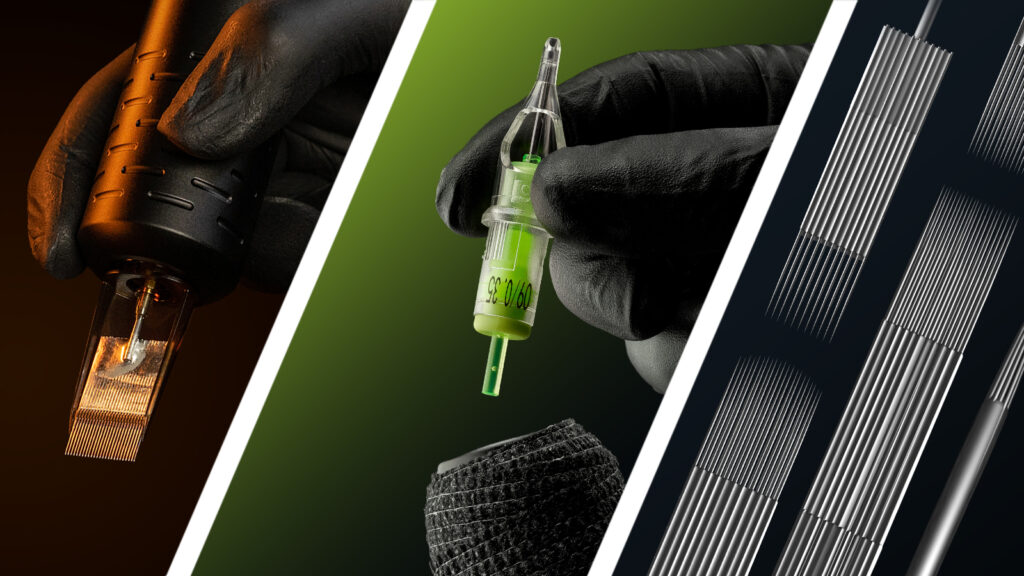
Tattoo needles are one of the more complex pieces of equipment in a tattoo artist's toolkit. At first glance, they might all look pretty similar, but different tapers, gauges, counts, and configurations can completely change the way a tattoo goes into the skin.
Understanding how tattoo needles work can help you choose the right setup for your style, whether you’re laying down bold traditional lines, creating smooth black and grey shading, or packing colour efficiently. In this guide, we’ll break down everything you need to know about tattoo needles, including taper length, configurations, diameter, needle count, and how each variation affects the final result.
What Is A Tattoo Needle?
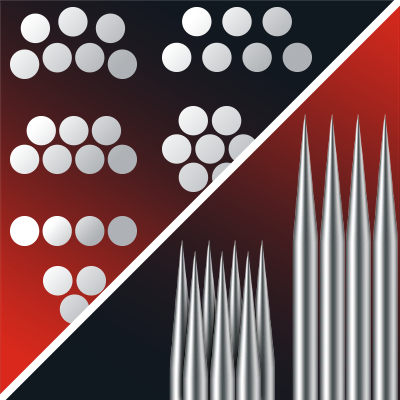
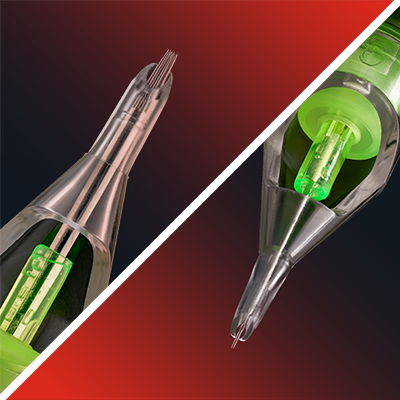
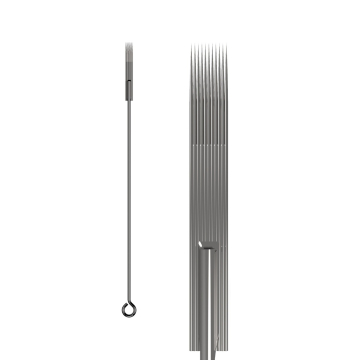
As simple as it sounds, a tattoo needle is a group of several smaller needles that have been soldered together in a specific configuration and attached to a needle bar. The way these needles are grouped and shaped determines their use - whether it's for outlining, shading, or creating intricate details.
While traditional tattoo needles are attached to a needle bar, tattoo cartridges feature an all-in-one disposable housing that allows artists to quickly switch configurations during a session. To learn more about cartridges, check out our guide to the best tattoo cartridges.
What To Consider When Choosing Tattoo Needles?
There are several factors to consider before choosing a tattoo needle, including:
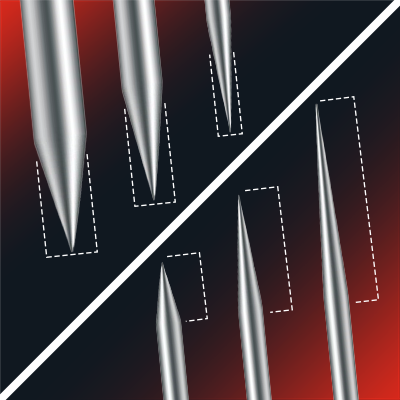
- Taper length: This refers to the tip of the needle to where it starts to taper off or slant, which can determine how sharp the needle is. The sharpness can impact the suitability of the needle for different techniques.
- Configuration: The grouping or shape of the individual needles, such as round liner, round shader, curved magnum, or stacked magnum.
- Diameter: The thickness of the individual needles.
While each needle is designed for a specific purpose, artists often experiment to find what works best for their unique style. Understanding how these features work together can make a huge difference in the way your tattoos heal and look once settled.
Understanding Taper Lengths
The taper refers to the length from the needle's tip to where it starts to taper sideways. Taper lengths can impact sharpness, ink flow, and how the skin reacts to the needle.
- Short Taper (1.5mm) - Creates thick lines and is ideal for bold shading. Short taper needles often hold more pigment, making them a good choice for packing colour quickly and efficiently.
- Medium Taper (2mm) - Offers a balance between boldness and precision. Often used for packing colour or creating clean, medium-thickness lines.
- Long Taper (2.5mm) - Ideal for delicate shading, fine lines, and smooth colour transitions. Long taper needles hold less pigment, allowing for gradual colour building and reduced skin trauma.
It's important to note that taper lengths can vary between brands, with some labelling them as LT (Long Taper), MT (Medium Taper), or ST (Short Taper). Some brands also offer Double Long Taper options for extra precision. Because of this, a 2mm taper could be classed as either medium or long taper depending on the manufacturer.
Tattoo Needle Configurations
The configuration describes how individual needles are grouped and what they’re designed to do. While there are lots of different needle configurations available, these are some of the most used.
Round Liner
Round liner needles are grouped in a circular formation and tapered to a fine point. Because the ink flow is more concentrated, round liners are perfect for creating clean outlines, fine details, dot work, and stippling.
Round Shader
Round shaders are grouped similarly to round liners but without the tight point. This allows the ink to disperse more evenly, making them ideal for softer shading, blending, and filling smaller areas.
Magnum
Magnum needles are designed to cover larger areas more efficiently and are commonly used for shading and colour packing. There are several different magnum variations, each offering a slightly different feel and ink flow.
Curved / Soft Edge Magnum
Curved or soft edge magnums feature a rounded edge that follows the natural curve of the skin more comfortably. They’re a popular choice for smooth shading and softer blends while reducing trauma to the skin.
Weaved Magnum
Weaved magnums have a looser needle grouping with slightly more space between each needle. This increases ink flow, making them ideal for packing colour into larger areas.
Stacked Magnum
Stacked magnums have a tighter grouping than weaved magnums, giving artists more control and precision. They’re often used for more detailed shading and controlled colour packing.
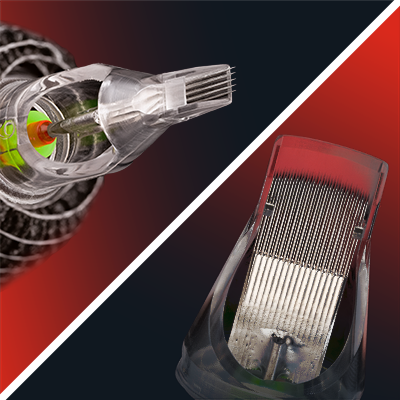
Flat
Flat needles are arranged in a straight line. Their shape makes them perfect for geometric work, bold lines, and more solid shading techniques.
The configurations might also be labelled as tight or super tight, which refers to how much space is between the individual needles. This affects both the ink flow and the overall effect the needle creates in the skin.
Diameter: The Gauge of Tattoo Needles
The diameter, or gauge, refers to the thickness of the individual needles, which directly affects how ink is deposited into the skin.
- Precision Tattoo Needles - Also known as a 12 gauge, 0.35mm, or standard needle. Precision tattoo needles are thicker, meaning they create larger holes in the skin and deposit more ink. They’re ideal for bold lines, heavy blackwork, and solid colour packing.
- Double Zero Tattoo Needles - Also known as a 10 gauge or 0.30mm. These needles offer a good balance between precision and ink flow, making them great for smooth shading, softer transitions, and versatile everyday work.
- Bugpin Tattoo Needles - Also known as an 08 gauge or 0.25mm. Bugpin needles are much thinner, making them perfect for intricate detail work, delicate shading, and smooth black and grey transitions.
Some artists use the term “Bugpin” to describe both 08 and 10 gauge needles depending on personal preference or brand terminology, so it’s always worth double-checking the specifications before ordering.
What Is Needle Count?
The needle count refers to the number of individual needles within a grouping, as indicated in the needle’s labelling.
For example, a 3RL consists of three individual needles grouped in a round liner configuration. A larger grouping, such as a 15M1C, contains fifteen needles in a curved magnum configuration and is better suited for covering larger areas.
Higher needle counts generally provide greater coverage and ink flow, while lower counts offer more precision and control.
Tattoo Needles Comparison
Changing just one element of a tattoo needle, whether that’s the taper, gauge, or configuration, can completely change the effect it creates in the skin.
12 3RL LT vs. 10 3RL LT
The 12 3RL LT has a larger diameter (0.35mm), allowing it to deposit more ink into the skin with each pass. This makes it ideal for bold, crisp outlines and strong traditional-style linework.
Because of its larger size, it can create slightly more trauma to the skin, but it’s a solid choice for artists looking for bold, saturated lines.
In contrast, the 10 3RL LT has a thinner 0.30mm diameter, making it gentler on the skin and better suited to delicate detail work. It creates finer, more precise lines and smoother transitions, although it deposits less ink per pass.
12 3RS MT vs. 12 3RS ST
The 12 3RS MT features a medium taper of around 2mm, making it a versatile choice for soft shading and smooth blends. Its more controlled pigment delivery makes it ideal for building gradients gradually.
The 12 3RS ST has a shorter taper of around 1.5mm, allowing it to deliver more ink into the skin faster. This makes it more effective for dense shading and colour packing, although it can increase skin trauma if overworked.
These comparisons show how even small changes in taper or gauge can significantly affect ink flow, skin trauma, and the final healed result.
Recommended Tattoo Needles
There’s no single ‘best’ tattoo needle. It all comes down to your style, machine setup, and personal preference. That said, these are some seriously reliable options trusted by artists across a wide range of tattoo styles.
- Killer Ink Precision Needles #12 - ideal for artists who want bold lines, strong saturation, and reliable ink flow. They’re a solid everyday choice for traditional work, blackwork, and colour packing.
- Killer Ink Double Zero #10 range - offers a great balance between precision and versatility, making them perfect for smooth shading, softer blends, and detailed linework.
- Killer Ink Bugpin Needles #08 – a great option if you’re focused on fine detail, black and grey realism, or delicate transitions thanks to their thinner diameter and smoother ink delivery.
- Kwadron needles - well known for their consistency, sharpness, and precision. They’re especially popular among artists working in realism, fine line, and highly detailed styles.
- Magic Moon needles - a reliable choice for artists looking for smooth performance and clean results across lining, shading, and colour work.
- Black N Gold tattoo needles - popular for their precision manufacturing and dependable quality, making them a strong all-round option for professional tattoo artists.
For a more detailed breakdown of different needle brands and configurations, check out our guide to the best tattoo needles.
Products
Choosing the Right Needle for Your Technique
Tattoo needles aren’t one-size-fits-all. The right choice depends on your style and the effect you want to achieve. Experimenting with configurations, tapers, and diameters will help you discover what works best for you.
Tattoo needles are more than just tools; they’re an extension of the artist’s creativity. By understanding the different configurations, tapers, and diameters, you can start to perfect your technique.